
High-Tech, Low-Tech Solutions
High-Tech, Low-Tech Solutions: skills-focused lessons even in the remotest classrooms!
Dr Miriam Mason-Sesay (Country Director, EducAid Sierra Leone)
From December 3 to 5, 2025, the GPE KIX A19 and A21 Hubs jointly organized the fourth edition of the GPE KIX Continental Symposium on Research and Innovation in Education in Africa in Senegal. Bringing together more than 150 key education stakeholders, the symposium was held under the theme “Professional development of teachers in sub-Saharan Africa in the age of artificial intelligence (AI): challenges and prospects for educational research.” Over the three days, participants explored the use of AI throughout the education system, from the government level to classrooms, and also engaged in deep discussions about the potentials and limitations of AI.
In this blog post, we hear from Dr Miriam Mason-Sesay, Country Director of EducAid Sierra Leone, who attended the Symposium and shared their innovative work with AI for education.
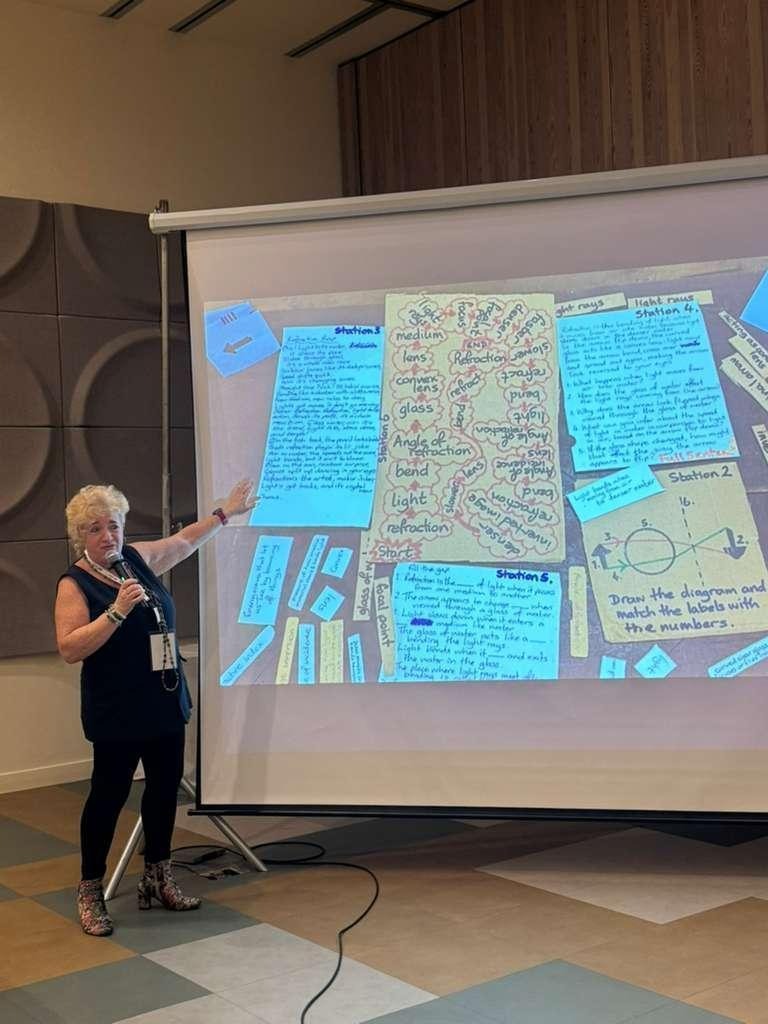
In early December, the 4th edition of the GPE KIX Continental Symposium on Research and Innovation in Education in Africa was organized in Senegal. Under the theme “Professional development of teachers in sub-Saharan Africa in the age of artificial intelligence (AI): challenges and prospects for educational research,” researchers, government officials and other key stakeholders came together to discuss the challenges and potentials of AI in education. More specifically, the 4th Symposium explored how AI could be harnessed to train, re-train, and support these teachers to improve their teaching and resilience in the face of challenges and limited resources.
As the Country Director of EducAid Sierra Leone, I was invited to present our innovative work with AI for education. EducAid is a Sierra Leonean non-profit organisation and UK registered charity, running schools and school improvement programmes working to transform education in Sierra Leone. We partner with the Ministry of Education to ensure the District Ministry teams have the necessary support to tackle learning poverty – the proportion of children who are unable to read and understand a simple text by age 10. In Sierra Leone, the learning poverty is currently 95.8%.
EducAid has been working to bring high-quality education to Sierra Leone for more than 30 years, growing from one school serving 20 learners in September 2000, to a strong team of 150 serving over 250,000 learners in 2025/26.
In Sierra Leone, education faces significant challenges including high student–teacher ratios, limited infrastructure, and widespread learning poverty (95.8 percent of 10-year-old children, for example, were unable to read and understand an age-appropriate text in 2022). With teachers often responsible for large classes and only 6 percent of schools having electricity and just 1 percent with internet access, providing quality education in this resource-constrained environment is a formidable task. Compounding these issues is the low qualification level among many teachers, which further impacts the quality of education delivered.
These challenges are shared by other countries across sub-Saharan Africa. Thus, my presentation at the Symposium focused on ‘Professional development of teachers in sub-Saharan Africa in the age of artificial intelligence (AI): challenges and prospects for educational research.’ We are convinced that if we think and work together creatively and ensure a people-centred approach, AI can help challenge learning poverty even in the remotest contexts. It is important to share these ideas.
If we think and work together creatively and ensure a people-centred approach, AI can help challenge learning poverty even in the remotest contexts.
Hi-tech adapted to local context
EducAid’s first collaboration in using AI for education was on a project with Fab AI in 2022. Fab AI created a ChatGPT-based AI chatbot, TheTeacher.AI. This chatbot leverages GPT-3.5 Turbo technology and is carefully adapted for the local context where mobile network coverage includes 93% 2G (83% 3G and 50% 4G) coverage. It operates on WhatsApp for its robustness under poor network conditions and data efficiency, as well as its familiarity among teachers, enabling accessibility even in the most underserved schools.
EducAid implemented preliminary research to see what levels of support were needed for teachers to feel comfortable asking the chatbot questions and to enable them to ask questions in such a way as to get useful answers. The tool was piloted with 40 teachers per group:
- Group 1: Early access and introduction to the tool
- Group 2: Access and a short introductory level training
- Group 3: Access, full training on crafting prompts, and coaching
- Group 4: Served as the control group with access only in the final month but with no other support
This work revealed that TheTeacher.AI can serve diverse educational needs, including concept clarification, lesson planning, and writing support, with teachers using it to generate vocabulary lists, explanatory texts, practice questions, and more across various subjects like mathematics, science, and business economics.
Despite the very real infrastructure challenges, it was found that TheTeacher.AI still shows the promising role AI can play in supporting educators in low-resource settings. Successful implementation hinges on careful adaptation to local conditions, continuous human oversight to ensure quality and accuracy, and leveraging existing technologies that are already embedded in community use. Teachers with no coaching support tended to use the tool briefly and then stopped. Teachers with coaching used the tool most and for the widest range of uses.
“For students in our schools, AI tools help by giving lessons that match how each student learns. Whether you need extra help or can move faster, AI helps you learn at your own pace.”
EducAid School Leader, Port Loko District, March 2025
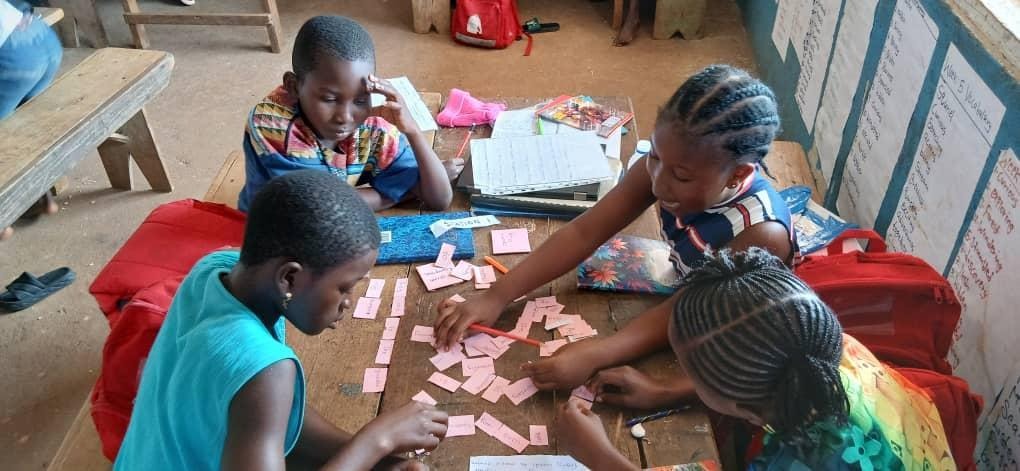
Students at EducAid Maronka, engaged in practising their reading skills.
Drawing on this success, EducAid has been further supporting teachers to use a range of AI tools that go beyond the WhatsApp-based chatbot, and to use them for designing engaging lessons. For many teachers in Sierra Leone, the priority is on “covering the syllabus” without ensuring student learning. In addition, many teachers are without access to textbooks. Implementing the use of AI tools (Pi.ai, Perplexity.ai, ChatGPT, CoPilot and even Suno.ai for creating learning songs), teachers are learning to create content, glossaries, activities and questions (including practice exam questions). The result is more engaging lessons, a movement away from just presenting content and understanding how to create opportunities for learning skills and practising them.
Low-tech for game-based learning
But how can teachers give a class of children access to these materials when there is no printer and only limited paper? This is where the low-tech piece comes in. Teachers are transcribing the AI output onto flattened cardboard boxes, creating a range of activities that can be used in a carousel.
In a 60-minute lesson, learners might spend 10 minutes on a carousel having started with a short introductory explanation and then ending with an exit ticket. With a focus on creating opportunities for children to practice speaking, listening, reading and writing about the correct vocabulary, the lessons are more interactive and result in genuine learning and skills acquisition.
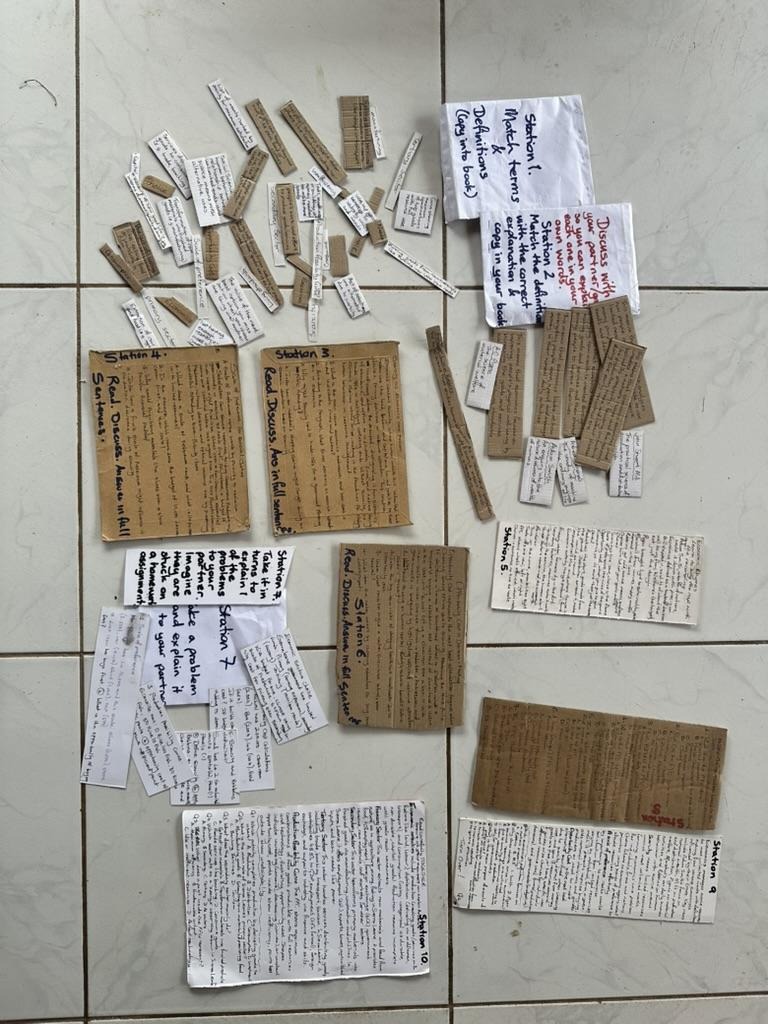
10 stations (enough for 2 lessons) on the scope and nature of Economics.
The biggest reason this approach has been found, in early observations, to be important, is that it enables even under-resourced teachers and schools to move away from just ‘covering the syllabus’ to focus on creating opportunities for practising core skills and using newly acquired vocabulary accurately to explain, orally and in writing, the concepts being studied. This creates tools for learner-centred and skills-focused teaching.
As we expand this work into more and more schools (in 2026, we will be working with 1200+ schools at both primary and secondary level), we will be assessing the impact on teacher workload and student learning. Thank you to KIX and GPE for the opportunity to share this work that is helping bridge the digital gap and reduce learning poverty in one of the world’s most underserved countries.
Although the majority of the symposium presentations focused on high-tech applications for managing and improving education services, EducAid’s presentation was unique in showing how students without devices can benefit from an AI-enhanced solution. There was considerable interest shown in this approach, with many symposium participants requesting the slides and asking further questions about how this can be implemented. This strong engagement confirms both the relevance of low-tech, inclusive approaches and the growing global need for practical AI solutions that leave no learner behind.
Find out more about EducAid: www.educaid.org.uk
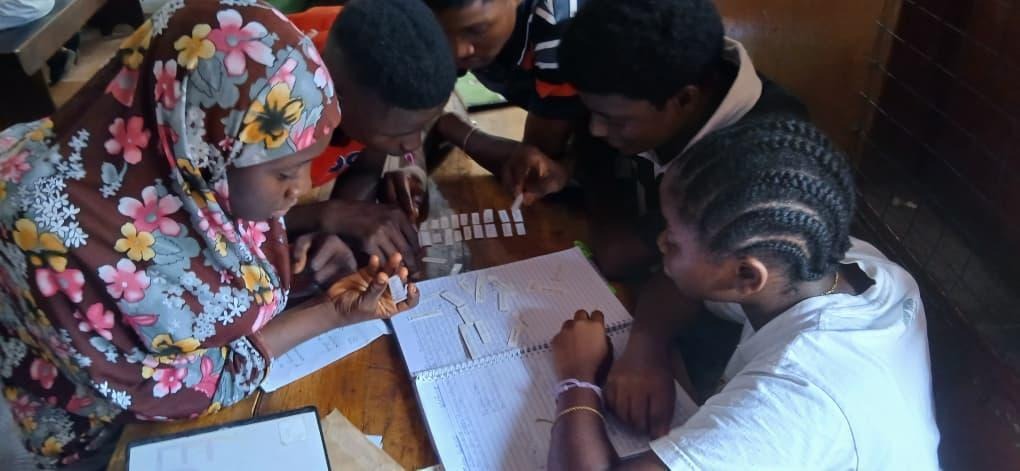
EducAid students practising their reading skills
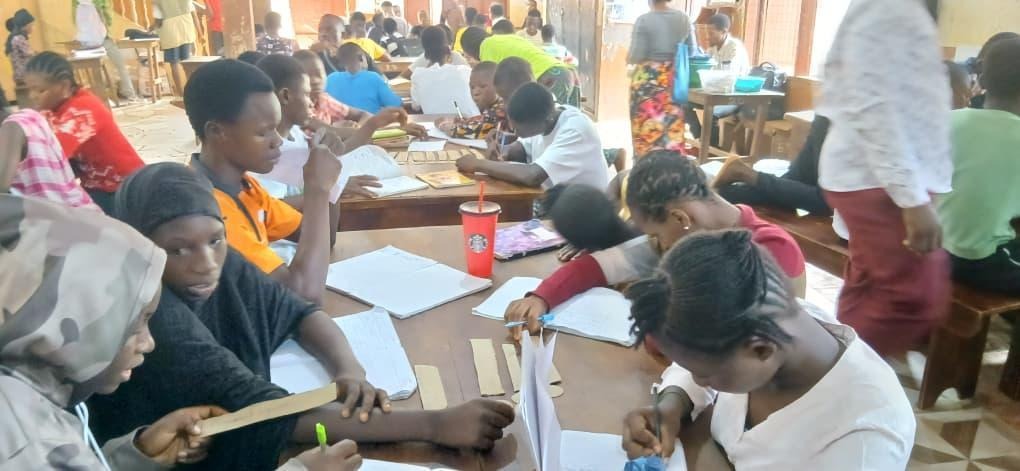
All learners actively engaged