
Education System Strengthening
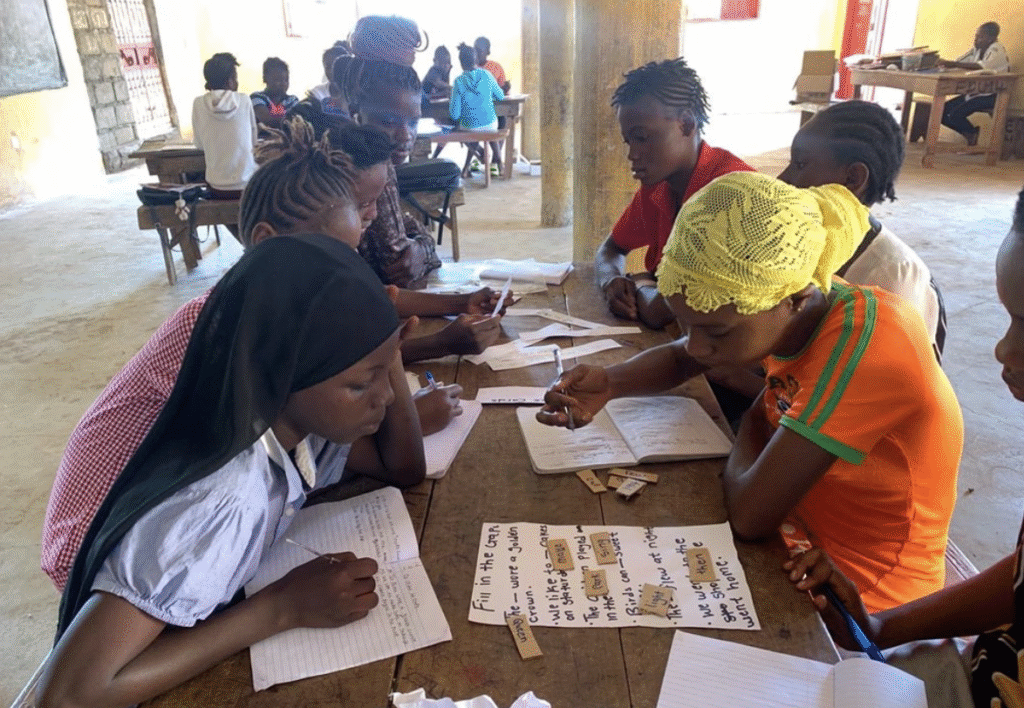
Slow Down to Speed Up! How EducAid is supporting education system strengthening through targeted priorities, coaching and logistical support
What’s the challenge?
The Global Education Policy Dashboard for Sierra Leone indicates a learning poverty rate for Sierra Leone in 2025 of 95.8%. According to the Education Sector Plan 2022 – 26 (Government of Sierra Leone, 2022), “30% of students fail to complete basic education”. The evidence is clear: the need for radical change and system-wide strengthening is significant.
The education system in Sierra Leone operates across its 16 districts, with each supported by a Ministry of Basic and Senior Secondary Education (MBSSE) team responsible for ensuring quality and oversight. In districts such as Port Loko, 16 School Quality Assurance Officers (SQAOs) serve more than 50 schools each. The scale of their task is immense. SQAOs work to support schools, ensuring high quality teaching and learning as well as compliance with all relevant policies. However, limited framework and inconsistent resources have made it difficult for officers to reach every school as regularly as needed. This has meant that the level of support and supervision available to schools, particularly those in remote areas, has not been sufficient. As a result, challenges in attendance, safety and learning outcomes have persisted. Port Loko was one district identified by the MBSSE in 2022 as underperforming.
In the same year, EducAid had the opportunity to partner with the MBSSE to better understand some of the causes of underperformance through a Harvard University course on Problem Driven Iterative Adaptation (PDIA) and explore how we might be able to collaborate to bring the necessary change. During the course, MBSSE Port Loko District team members and EducAid staff grappled with understanding not only the causes of underperformance and challenges, but also what solutions we could trial. The result was a motivated team, energised and ready to work together to tackle the issues we had uncovered.
Concurrently, building on years of education work in Sierra Leone, EducAid had another opportunity to work with the Research Triangle Institute, merging the Science of Teaching (SoT) thinking with our own learning and experience to create EducAid’s Top Ten Strategies for Teaching and Learning. These Strategies address classroom relationships and pedagogical approaches. Having run a highly successful trial of the Strategies in 20 schools in Port Loko District, we realised that this could help us address many of the issues we had encountered during our PDIA investigations. A plan evolved: with unified messaging, coaching and logistical support, EducAid and the Ministry of Basic & Senior Secondary Education (MBSSE) District team are working together to roll out the strategies to all the schools in Port Loko District*. By aligning our work and helping to set targeted district education priorities, we are creating the conditions for systemic change.
*The project is currently implemented in Port Loko District as a model to guide similar efforts across other districts and contexts, with the aim of scaling it further in the future.
The District of Excellence Project
The District of Excellence approach focuses on three priorities:
- Making sure that children are in school for 6 hours every day of term.
- Keeping children safe in school, focusing on robust child protection and safeguarding protocols and positive behaviour management approaches.
- Ensuring that children are learning in every lesson in every school.
The District of Excellence is the collaborative rebuilding of structures that are both enabling the MBSSE team to reach and support every school in the district with clear target behaviours and drawing in all those with a stake in education to ensure that everyone pulls in the same direction.
The collaboration includes:
- A project coordinator seated within the Port Loko MBSSE office, who is working directly alongside government leadership (MBSSE and Teaching Service Commission) to provide daily support as required by the District leaders.
- Seven EducAid coaches who, with the MBSSE District field team, deliver consistent messages across schools through training meetings, joint school visits for lesson observations and coaching. They also provide training and coaching in the use of key digital tools for improved efficiency and effectiveness.
- Shared data tools to support the District leadership team’s management of the field team and their ability to provide accurate data on schools, teachers and enrollment to the MBSSE Headquarters.
- Monthly planning meetings with the MBSSE District leadership team.
- Twice termly learning meetings and workshops on the three priorities and the corresponding implementation instruments as well as on digital tools such as online calendars, online meeting apps and on the use of AI tools to enhance lesson planning and activity design, bridging gaps in resources such as text books.
- A week-long summer camp with the entire MBSSE District team to learn and plan together for a successful year of district-wide reform.
- Essential logistical support, in the form of fuel, mobile phone data, rain gear etc., making it possible for SQAOs to reach all the schools in their care, even the most remote and hardest to reach.
- Copies of the Top Ten Strategies (TTS) booklets supplied to each school and illustrative videos of the TTS in practice. The videos were made by Sierra Leonean teachers in schools within the district. This provides a common understanding of the target teacher behaviours and practices as well as accessible examples to guide teachers.
- Engagement with all education stakeholders in the district including other ministries, the police, the paramount and section chiefs and families through in-person meetings and on radio discussion programmes on the DoE priorities.
As a result of this collaborative project, the MBSSE District leadership team:
- Runs daily briefing meetings for the office-based staff to plan the team’s activities and keep each other informed and on the same page.
- Holds weekly office-based data meetings to understand where the SQAOs have been and what they have been doing.
- Has weekly online meetings with the whole field team, giving feedback to the SQAOs on the data and the progress being made.
All of this is resulting in an optimisation of the professional use of the day by the field teams and enhanced efficiency of the whole District team.
This model emphasises focus on three key priorities, implemented consistently, to unlock lasting improvement. By aligning stakeholders around a shared vision of quality education, EducAid is catalysing an ecosystem transformation. Every meeting, workshop, radio broadcast, WhatsApp group and school visit reinforces the same core message: children must be in school, safe, and learning.
In practice – what is this changing?
Early in the project, one School Quality Assurance Officer (SQAO) shared an important reflection. At the start of the District of Excellence project, he had planned to remain in Freetown during the first week of term, assuming that he had no role until several weeks into the term when attendance had regularised. However, through the project and with EducAid’s coaching, he recognised the crucial role he plays in ensuring that schools start effectively from the first day of term.
Today, that same SQAO has become a local champion for change. He even sometimes chooses to use his own funds to provide additional resources for his schools and has organised teacher workshops to explore the accompanying TTS training videos – helping the teachers in his schools become more effective through adopting the strategies.
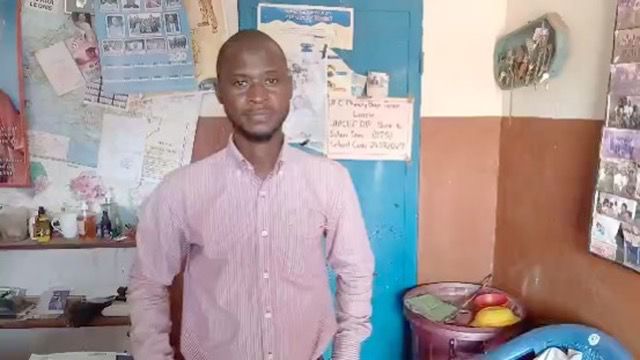
When asked what has changed in his work, he reflected:
“I’m now more enlightened about my roles and responsibilities, I use Google Calendar to plan and monitor effectively. I’m more detailed in giving lesson observations and feedback. I’m more dutiful and assertive in supporting schools than in the past.”
He notes that the results are tangible amongst educators:
“We’re now protecting learning time through the calendar, improving teacher and pupil attendance, strengthening child safety, and creating a calmer, more welcoming environment for children.”
Other Ministry team members report similar impacts and behaviour changes. The recently retired Director of School Quality Assurance & Resource Management said:
“Today, Port Loko is rightly regarded as one of the most outstanding Districts in Sierra Leone for school monitoring and staff management. The Port Loko District team’s success is visible in both the numbers and the narrative reports—from improved school attendance rates (rising from 68% to 82%) to better teacher performance (successful CASS submission by school leaders) and increased stakeholder engagement.”
These results demonstrate what can be achieved when focus, collaboration, and consistency come together. If we remain strategic—concentrating on a few foundational priorities at a time—we can build a stronger future for Sierra Leone’s education system, one district at a time.
Find out more about EducAid’s work here.
References
https://www.educationpolicydashboard.org/indicator_timetrend/sle/44/44Government of Sierra Leone. (2022). Sierra Leone Education Sector Plan: Transforming Learning for All – 2022-2026. https://planipolis.iiep.unesco.org/sites/default/files/ressources/sierra_leone_education_sector_plan_2022_-_2026.pdf
Government of Sierra Leone, Ministry of Basic and Senior Secondary Education, & Ministry of Technical and Higher Education. (2022). Sierra Leone education sector plan 2022–2026: Transforming learning for all. Government of Sierra Leone.